

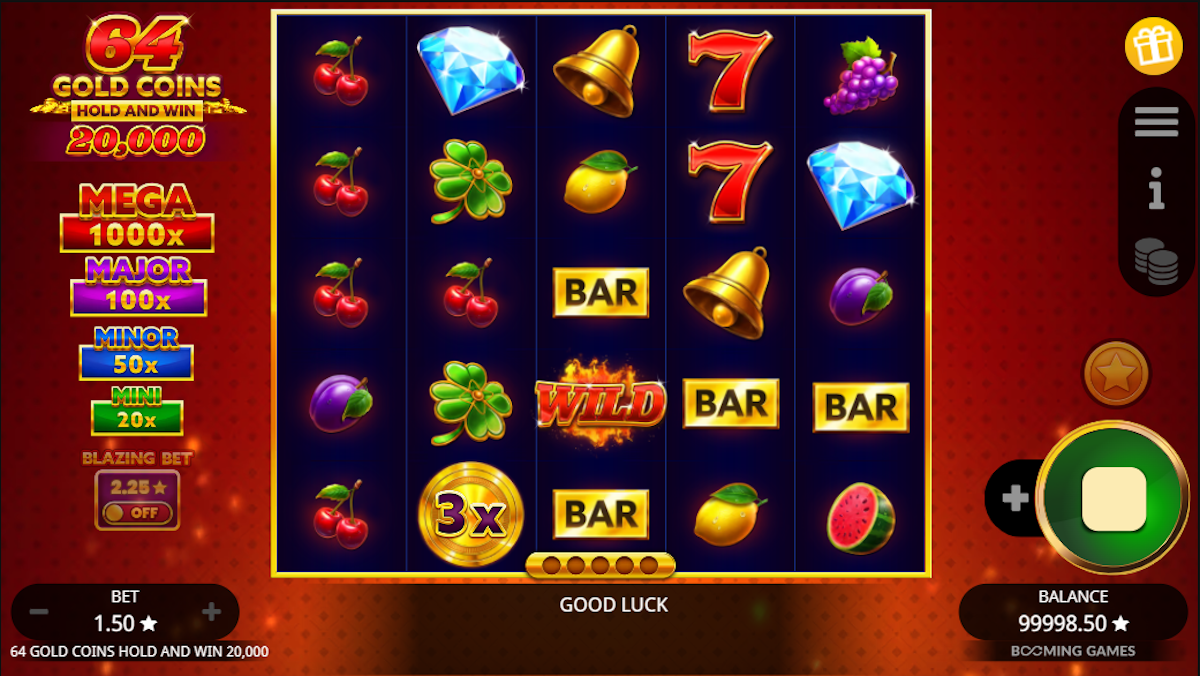
Hold and Win Slots is a specific style of slot that merges fixed-reel layouts with a bonus round where special symbols lock in place while the remaining reels proceed to spin https://holdandwin.org/. Grasping the payout percentage, volatility profile and the exact mechanics of the hold-and-win feature is essential for anyone who wants to decide whether these games match their bankroll and playing style. This guide walks through the concrete numbers you should check, the reel configurations you will meet and the practical steps you can take to manage risk while chasing the fixed or progressive jackpots that characterize the format.
Understanding Hold and Win Mechanics

Hold and Win Games center on a two-stage layout: the base game and a separate hold-and-win bonus. In the base game you commonly see a 5×3 reel grid with 10 to 25 fixed paylines. Regular line wins pay left to right, but the real action begins when six or more special coin symbols land anywhere on the reels. Those coins lock in place, the rest of the grid resets to blank positions, and you obtain three respins. Every new coin that lands sticks and resets the counter, giving the round a chance to extend well beyond the initial three spins. The round ends only when you run out of respins or fill the entire grid, at which point the values shown on the coins are added together and paid out.
The coins themselves carry either cash amounts or jackpot labels. A typical grid presents four jackpot tiers: Mini, Minor, Major and Grand. The Grand can be fixed or progressive, depending on the title. Because the bonus round is self-contained, the RTP contribution from the hold-and-win feature is calculated separately from the base game. Providers release an overall RTP figure, but they rarely break out the exact split; the only reliable way to verify is to open the game’s information panel before you play.
Stake Range, Coin Sizes and Maximum Exposure
Bet flexibility changes significantly. Entry-level bets begin at 0.10 per spin, reached by choosing the lowest coin value of 0.01 and one coin per line. The maximum limit on UK-licensed sites is capped at £2.00 per spin for players under 25 and £5.00 for players 25 and over, following the 2021 stake-restriction rules. These caps apply to every spin, including the hold-and-win respins, so you may not raise your stake once the bonus has begun.
Max exposure, shown as a multiple of the total stake, varies from 1,000× to 5,000× in fixed-jackpot titles and can exceed 10,000× when a progressive Grand is present. The 5,000× cap is typical because it satisfies the UK’s stake-to-prize ratio without requiring operator-side progressive pools. Make sure to check the promoted maximum win in the paytable; some games present the figure as a cash amount rather than a multiplier, which can be confusing if the stake displayed is not your actual bet.
Typical RTP Ranges Among Hold and Win Titles
The majority of Hold and Win Games fall between 95.5 % and 96.8 % RTP when used at the maximum bet. The lower end of that range commonly occurs in games that feature a progressive Grand jackpot funded by a small percentage of every stake. Higher RTP figures are more common in fixed-jackpot versions where the entire prize pool is settled from the base RTP rather than from an accumulating pool. Because the difference between 95.5 % and 96.8 % can turn into several hundred pounds over a long session, it benefits to compare the published RTP on each title’s help screen before allocating a bankroll.
Some studios present two RTP configurations for the same game, one for UK-licensed sites and another for other markets. The UK version is almost always the lower of the two because of stricter stake-to-prize ratios. If you cannot locate the RTP inside the game, consult the operator’s game rules page; under UK rules the figure must be shown either in the paytable or in a separate information tab. Consider any game that fails to publish its RTP as an immediate red flag.
Risk Levels and Their Impact Your Balance
Hold & Win Slots are typically moderate to high risk. The standard play produces frequent small line wins, but the majority of the return is concentrated in the hold-and-win round. This leads to extended periods of empty spins punctuated by occasional large payouts. An effective method to gauge the precise variance is to look at the hit frequency of the bonus activation. If six coins hit about once per 180 spins, you can anticipate the bonus to appear about every 30 to 40 minutes at a spin rate of six spins per minute.
Since the variance is concentrated in the bonus, your playing session duration needs to be based on that period. A brief 15-minute play is rarely triggers the bonus round, but a 60-minute session provides a genuine opportunity of encountering at least one full hold-and-win bonus. Establishing a firm loss cap prior to playing stops the frequent mistake of upping wagers after a losing streak in an effort to activate the bonus round.
Extra Features: Complimentary Spins, Wild Symbols and Dispersers
Even though the hold to win round is the main feature, many titles incorporate additional enhancements onto the core game. Scatters typically act as bonus initiators; three plus will award from eight to twelve complimentary spins. In those spins the hold to win coins maintain their sticky behaviour, but the respin counter is replaced by a set number of gratis spins. This mixed approach offers you two separate paths to the same coin-collector mechanic and can produce long sequences when complimentary spins repeatedly feed coins into the grid.
Wild characters occur on reels two, three and four in most five-by-three layouts. They substitute for all standard symbols but at no time for the special coins or dispersers. Some games feature a multiplier wild symbol that implements a ×2 or ×3 multiply factor to any row win it finishes. Because the multiplying factor works only to row wins and not to coin values, its overall contribution to Return to Player is small, yet it delivers a welcome boost during the main game and can turn an otherwise break-even spin into a slight gain.
Reel Setups, Paylines and Ways-to-Win Structures
The majority of Hold and Win Games employ a 5×3 grid with 10, 20 or 25 fixed paylines. A smaller but expanding number of titles feature a 5×4 layout with 40 lines or a 6×3 layout with 30 lines. Paylines are fixed, so you can’t reduce the number of active lines to lower your total stake; the only variable is the coin value or bet level. This structure keeps the maths consistent across all stake sizes and stops players from inadvertently diluting the RTP by deactivating lines.
Some newer releases substitute traditional paylines with a ways-to-win engine that counts matching symbols on adjacent reels regardless of exact position. In a 5-reel ways game you need matching symbols on reels one and two, two and three, and so on, with each additional reel multiplying the number of possible combinations. The hold-and-win bonus still triggers on six or more coins, but the base-game hit rate is usually higher because ways games produce more small wins. The trade-off is that the maximum line win is often lower, shifting even more of the RTP into the bonus round.
Well-known Providers and Outstanding Titles
Playson’s Coin Strike: Hold and Win and Coin Trio: Hold and Win both employ a 5×3, 10-line layout with a 96.1 % RTP and a 2,500× maximum win. The coin values adjust with stake, so a £1.00 bet can generate Mini and Minor jackpots worth £20 and £100 respectively, while the fixed Major pays £500. The Grand is a progressive that starts at £5,000 and grows until claimed.

BGaming’s 3 Super 7’s Hold and Win and 5 Super 7’s Hold and Win shift the grid to 5×4 and 6×3 respectively, boosting the number of coin landing positions and therefore the bonus frequency. Both titles list an RTP of 96.4 % and claim a 4,000× cap. the truth Because the reels are taller, the base-game hit rate rises, but the average coin value is lower to keep the overall RTP unchanged. Checking the paytable before you play will show you the exact coin denominations for your chosen stake.
How to Play the Game: Detailed Game Walkthrough
Start by opening the game and expanding the cointelegraph.com information panel. Note the listed RTP, the highest win multiplier and the specific coin values at your selected stake. Define a loss limit equal to 50–75 spins at that stake; this offers you adequate time to see at least one bonus trigger while safeguarding your bankroll from long dry spells.
Spin the reels at a steady pace. Watch for the coin counter in the bottom right; once six coins land, the hold-and-win round starts automatically. During respins, avoid the urge to raise the stake; the bonus round employs the same stake you started with. If the grid fills completely you will gather every visible value plus any jackpot labels. When the round ends, the total is added to your balance and you return to the base game. Repeat the process, changing your loss limit after each bonus rather than after each spin.
FAQ
Is the RTP consistent at all stake levels?
Correct. Hold and Win Games compute RTP as a long-term average across every stake level. The sole difference arises when a casino offers two separate RTP configurations; in that case the lesser amount applies at each stake level on that variant. Always verify the visible RTP in the information panel prior to starting a session.
Is it possible to alter the amount of active paylines?
No. Paylines are locked in every Hold and Win title. The only variables you can modify are coin value and bet level, each of which affect all lines equally. This structure keeps the maths consistent and stops accidental RTP reduction via line deactivation.
What is the duration of the hold-and-win bonus typically last?
The round starts with three respins. Every new coin renews the counter, thus the length depends on how frequently coins land. On average you obtain between six and ten respins, but streaks of ten or more may happen when the grid is rapidly filling. The entire sequence rarely exceeds thirty seconds of real spin time.
Are progressive jackpots available in the UK?
Indeed, only when the Grand jackpot is funded entirely from the game’s RTP as opposed to from an operator-run pool. The stake-to-prize regulations remain in effect, thus the maximum cash prize is limited. Review the paytable for the latest progressive seed and any visible cap before you play.
